
Does flag football ring a bell, yet?
In a school gym in North Holland, a group of children gathers around a ball that looks familiar—but not quite. It is long and oval, similar to a rugby ball, but coach Rakran Mateen holds and throws it differently. Around the children’s waists are belts with two small flags attached.
Some immediately ask what the flags are for. Others want to know whether they are allowed to run with the ball.
Rakran gives them a brief explanation, demonstrates how to pull a flag safely and then lets them try for themselves. Within minutes, the group is moving. Children run into open space, call for the ball, attempt their first catches and stop their opponents by pulling a flag rather than grabbing or tackling them. At the beginning of the lesson, most have never heard of flag football. By the end, they understand the basic idea and many are eager to keep playing.

For Rakran, head coach at TNS Academy, these introductory school sessions confirm something he already believed: flag football can work exceptionally well with children in the Netherlands.
“I started playing flag football when I was five years old,” Rakran says. “That was at the YMCA in Tampa Bay.”
For many families in the region, TNS Academy is best known for basketball. Rakran grew up playing basketball too, and the sport remains central to the academy’s programmes for children and young people.
Flag football and American football, however, have an especially important place in his personal story.
After first discovering flag football as a five-year-old in Tampa Bay, Rakran later earned a college football scholarship. He went on to play and coach American football in both the United States and Europe.
“When I introduce it here, it means a lot to me,” he says. “This is the game I grew up with.”
In Europe, he has coached youth American football and worked with both experienced teams and newer players still learning the game. That has shaped his approach: clear instruction, strong basics and steady improvement.
Flag football is closely connected to American football, but it is played without tackling. Players wear flags on a belt around their waist. To stop the child with the ball, the other team pulls one of those flags. The game keeps the running, passing and teamwork of American football, but removes the hard physical contact. Children do not need helmets, pads or previous experience.
The rules are simple enough to understand quickly, but the game still asks children to pay attention, react and work together.
In the Netherlands, some children may already have a reference point for the oval ball through rugby. But flag football has a different rhythm. Rugby is more physical and often built around carrying the ball forward with contact. Flag football is more about passing, timing, movement and stopping the play in a controlled way by pulling a flag.
“Flag football teaches children to understand space,” Rakran says. “They learn where to run, when to react, how to communicate and how to work together.”
The aim is not only to show them a new sport, but to help them leave with a better sense of movement, confidence and teamwork.
“With beginners, you have to build things properly,” Rakran says. “You can’t skip steps. If children understand the basics, they can grow.”
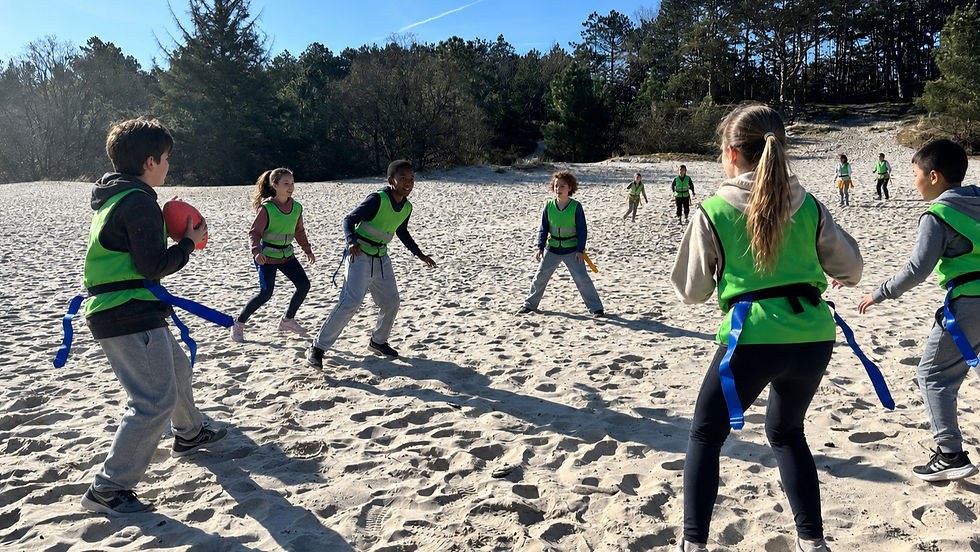
Flag football is also receiving more international attention. The sport will make its Olympic debut at the Los Angeles 2028 Games and is growing in different countries through schools, clubs and national teams. For Rakran, that global momentum is important, but the local response is what matters most right now.
“In America, many children know flag football,” he says. “Here, many are discovering it for the first time. That makes it exciting, because everyone can start fresh.”
The TNS Academy flag football summer sessions take place in Alkmaar and Camperduin. These summer sessions in Alkmaar and Camperduin are designed as a structured introduction. Children will learn the basics step by step and play simple game situations adapted to their age and level. Children can join once to try the sport, or attend multiple sessions to build their basic skills. No previous American football or flag football experience is needed, and no special equipment is required. The balls and flags are provided.


Comments